

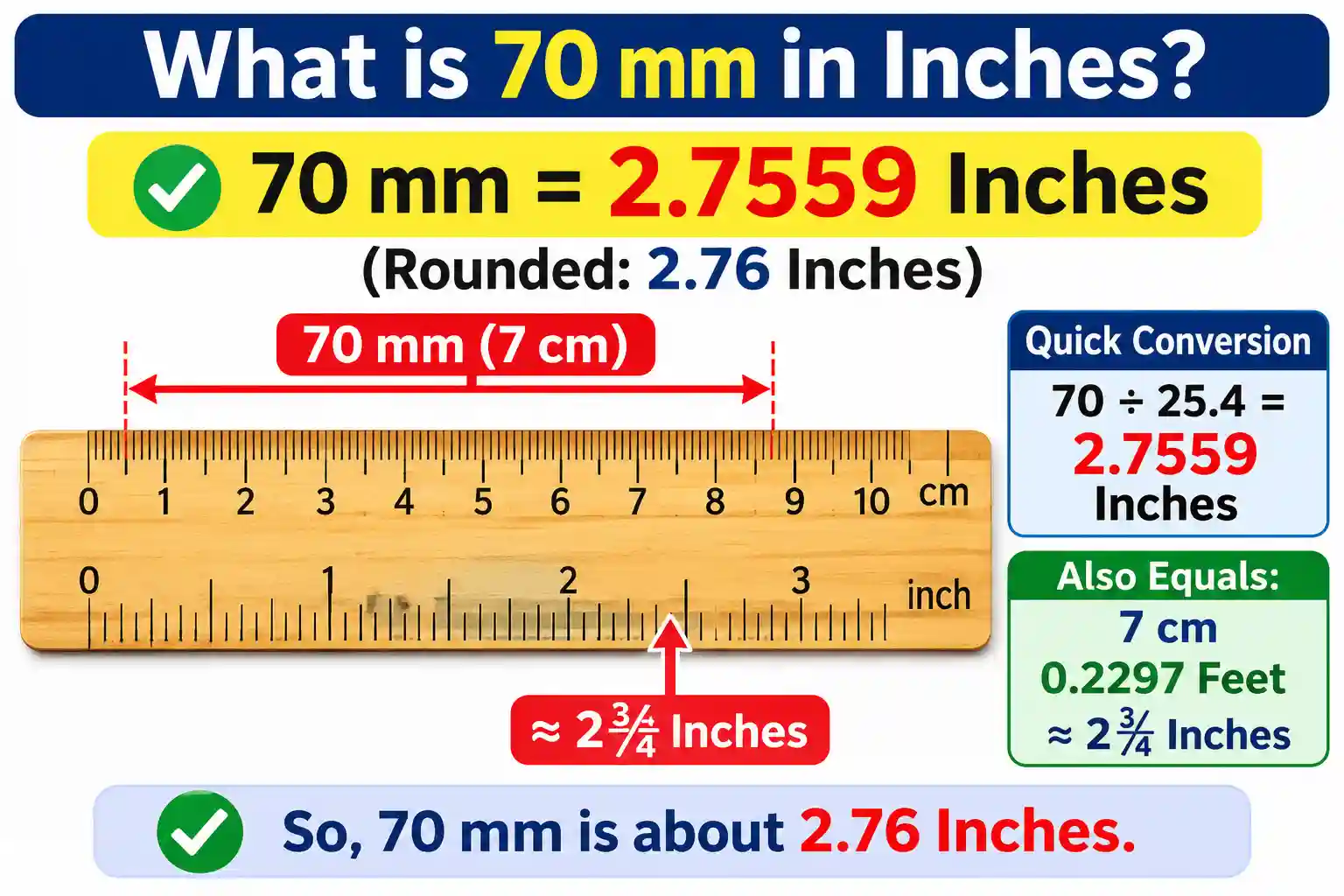
If you want to know what 70mm is in inches, the answer is 2.7559 inches. When rounded to two decimal places, this measurement becomes 2.76 inches.
In addition, 70 millimeters is approximately 2 3/4 inches. This measurement also equals 7 centimeters and about 0.2297 feet.
Understanding this conversion can help when measuring objects, comparing product dimensions, or working with different measuring tools. Therefore, this guide explains how to convert 70mm into inches, read the measurement on a ruler, and find its closest fraction. You will also find useful conversion charts for 75mm, 90mm, and 100mm.
What Is 70mm in Inches?
70 millimeters equals approximately 2.7559055 inches. For everyday measurements, you can round this result to 2.76 inches.
Here is a quick conversion table:
| Measurement | Result |
|---|---|
| 70mm in inches | 2.7559 inches |
| Rounded to 2 decimals | 2.76 inches |
| 70mm in feet | 0.2297 feet |
| 70mm in centimeters | 7cm |
| 70mm in meters | 0.07 meters |
| Nearest common fraction | 2 3/4 inches |
The exact decimal measurement is useful for precision work. However, the rounded value is easier to remember and use in everyday situations.
What Is 70mm in Inches on a Ruler?
On a metric ruler, 70mm appears at the 7cm mark. When using an inch ruler, the same measurement falls slightly after the 2 3/4-inch mark.
Follow these simple steps to locate it:
- Place the starting point of your object at zero.
- Find the 7cm mark on a metric ruler.
- Alternatively, locate the 2-inch mark on an inch ruler.
- Move toward the 3-inch measurement.
- Stop just beyond the 2 3/4-inch mark.
For more accurate measurements, you can also use a measuring tape or digital caliper.
70mm to Inches and Feet
You can convert 70mm into inches and feet by using simple mathematical formulas.
| Unit | Result |
|---|---|
| Inches | 2.7559 inches |
| Feet | 0.2297 feet |
| Feet and inches | 0 feet and 2.7559 inches |
To convert millimeters into inches, divide the measurement by 25.4.
Calculation:
70 ÷ 25.4 = 2.7559 inches
Similarly, converting millimeters into feet requires dividing by 304.8.
Calculation:
70 ÷ 304.8 = 0.2297 feet
Therefore, 70mm is approximately 2.76 inches or 0.23 feet.
What Is 70mm in Inches as a Fraction?
Some measuring tools display fractions instead of decimal measurements. For this reason, knowing the closest fraction can make measurements easier to understand.
70mm equals 2.7559 inches. Its nearest common ruler fraction is 2 3/4 inches.
| Fraction | Decimal |
|---|---|
| 2 1/2 inches | 2.5000 |
| 2 3/4 inches | 2.7500 |
| 2 25/32 inches | 2.78125 |
| 2 13/16 inches | 2.8125 |
| 3 inches | 3.0000 |
When rounded to the nearest 1/16, 1/32, or 1/64 inch, the result is still 2 3/4 inches.
However, this fraction is an approximation rather than an exact conversion. For precision measurements, use the decimal value of 2.7559 inches.
What Is 70mm in CM?
One centimeter contains exactly 10 millimeters. Therefore, converting 70mm into centimeters only requires dividing by 10.
Calculation:
70 ÷ 10 = 7cm
As a result, 70mm equals exactly 7 centimeters.
This conversion is especially useful when switching between metric measuring tools.
70mm in Meters and Other Units
Millimeters can also be converted into meters, feet, and other measurement units. The following table provides a quick reference.
| Unit | Result |
|---|---|
| Millimeters | 70mm |
| Centimeters | 7cm |
| Meters | 0.07m |
| Inches | 2.7559 inches |
| Feet | 0.2297 feet |
To change millimeters into meters, divide the original measurement by 1,000.
Calculation:
70 ÷ 1,000 = 0.07 meters
Likewise, the inch conversion uses 25.4 as the conversion factor.

What Is 70mm in Inches Height?
When measuring the height of a small object, 70mm represents approximately 2.76 inches.
This conversion can help when comparing product dimensions, checking the height of small components, or reading product specifications.
For example, a product listed as 70mm high measures slightly less than 2 3/4 inches plus a small additional amount.
What Is 70mm of Rain in Inches?
Rainfall measurements are commonly expressed in millimeters and inches. Converting between these units makes weather measurements easier to compare.
70mm of rainfall equals approximately 2.76 inches of rain.
This means that rainwater would reach a depth of about 2.76 inches on a flat surface if none of the water drained away or soaked into the ground.
What Is a 70mm Heel in Inches?
A 70mm heel measures approximately 2.76 inches in height.
This measurement is close to a 2 3/4-inch heel. Therefore, it can help shoppers compare shoe specifications when different brands use millimeters or inches.
Keep in mind that actual heel measurements may vary slightly depending on the shoe design and measurement method.
70mm vs. 2 3/4 Inches
Although 70mm and 2 3/4 inches are almost the same size, they are not exactly equal.
| Measurement | Millimeters |
|---|---|
| 70mm | 70mm |
| 2 3/4 inches | 69.85mm |
| Difference | 0.15mm |
The 70mm measurement is slightly larger than 2 3/4 inches.
For everyday projects, this difference is usually very small. Nevertheless, accurate technical work should use the exact decimal conversion.
MM to Inches Chart
A millimeter-to-inches chart helps you compare different measurements without calculating each value separately.
The following table includes common measurements, including 70mm, 75mm, 90mm, and 100mm.
| Millimeters | Inches |
|---|---|
| 1mm | 0.0394 |
| 5mm | 0.1969 |
| 10mm | 0.3937 |
| 15mm | 0.5906 |
| 20mm | 0.7874 |
| 25mm | 0.9843 |
| 30mm | 1.1811 |
| 40mm | 1.5748 |
| 50mm | 1.9685 |
| 60mm | 2.3622 |
| 70mm | 2.7559 |
| 75mm | 2.9528 |
| 80mm | 3.1496 |
| 90mm | 3.5433 |
| 100mm | 3.9370 |
| 110mm | 4.3307 |
| 120mm | 4.7244 |
| 150mm | 5.9055 |
| 200mm | 7.8740 |
All measurements are rounded to four decimal places. Consequently, small differences may appear when comparing these values with longer calculator results.
75mm to Inches
75mm equals approximately 2.9528 inches. Rounded to two decimal places, the result is 2.95 inches.
The calculation is simple:
75 ÷ 25.4 = 2.9528 inches
This measurement is slightly shorter than 3 inches.
90mm to Inches
A measurement of 90mm converts to approximately 3.5433 inches.
When rounded to two decimal places, it becomes 3.54 inches.
Calculation:
90 ÷ 25.4 = 3.5433 inches
Therefore, 90mm is slightly longer than 3 1/2 inches.

100mm to Inches
100mm equals approximately 3.937 inches. For everyday use, you can round this measurement to 3.94 inches.
Here is the calculation:
100 ÷ 25.4 = 3.937 inches
As a result, 100mm is just a little shorter than 4 inches.
How to Convert Millimeters to Inches
Converting millimeters into inches is straightforward when you know the correct formula.
Inches = Millimeters ÷ 25.4
For example, suppose you want to convert 70mm into inches.
70 ÷ 25.4 = 2.7559 inches
The same formula works for other measurements:
- 75 ÷ 25.4 = 2.9528 inches
- 90 ÷ 25.4 = 3.5433 inches
- 100 ÷ 25.4 = 3.937 inches
On the other hand, converting inches into millimeters requires a different formula.
Millimeters = Inches × 25.4
For example:
2.7559 × 25.4 ≈ 70mm
Using these two formulas, you can convert measurements in either direction.
How to Use an MM to Inches Calculator
An online conversion calculator can make measurement calculations faster and easier. Instead of performing the mathematical operation manually, you can enter a value and receive the result.
Follow these steps:
- Open a millimeter-to-inches conversion calculator.
- Enter the measurement you want to convert.
- Select inches as the output unit.
- Click the calculate or convert option.
- Check the displayed result.
For instance, entering 70mm will give you approximately 2.7559 inches.
Similarly, you can use the calculator for 75mm, 90mm, and 100mm measurements.
Metric System vs. Imperial System
The metric system and imperial system are two different ways of measuring length.
The metric system uses millimeters, centimeters, and meters. In comparison, the imperial system commonly uses inches, feet, and yards.
Here are some useful measurement conversions:
- 10mm = 0.3937 inches
- 25.4mm = 1 inch
- 50.8mm = 2 inches
- 70mm = 2.7559 inches
- 75mm = 2.9528 inches
- 90mm = 3.5433 inches
- 100mm = 3.937 inches
The conversion factor of 25.4 makes it easy to switch from millimeters to inches.
Frequently Asked Questions
70mm equals approximately 2.7559055 inches. When rounded to four decimal places, the result is 2.7559 inches.
On a metric ruler, 70mm appears at the 7cm mark. Meanwhile, an inch ruler shows this measurement slightly after 2 3/4 inches.
The nearest common ruler fraction is 2 3/4 inches. However, the exact decimal conversion is 2.7559 inches.
70mm equals approximately 0.2297 feet. This value is useful when converting small measurements into larger units.
70mm equals exactly 7 centimeters because one centimeter contains 10 millimeters.
70mm of rainfall is approximately 2.76 inches. This measurement describes the depth of rainfall collected on a flat surface.
A 70mm heel is approximately 2.76 inches high. Therefore, it is close to a 2 3/4-inch heel.
No, the measurements are not exactly equal. Although 2.75 inches equals 69.85mm, 70mm equals 2.7559 inches.
75mm converts to approximately 2.9528 inches. When rounded to two decimal places, it becomes 2.95 inches.
90mm equals approximately 3.5433 inches. For a simpler measurement, you can use 3.54 inches.
100mm converts to 3.937 inches. Rounded to two decimal places, the result is 3.94 inches.
One inch contains exactly 25.4 millimeters. This is the standard conversion used for changing measurements between the two systems.
Final Answer
70mm equals 2.7559 inches, or approximately 2.76 inches.
On a standard ruler, this measurement appears just after the 2 3/4-inch mark. Additionally, 70mm equals 7 centimeters and approximately 0.2297 feet.
For other common measurements, 75mm equals 2.9528 inches, 90mm equals 3.5433 inches, and 100mm equals 3.937 inches.
Remember this simple formula:
Inches = Millimeters ÷ 25.4
You can use it to convert any millimeter measurement into inches quickly and accurately.

Hi, I’m Marcus. I write conversion guides that turn confusing numbers into clear answers. Each article gives the exact value, a simple rounded version and real-life examples, so you can measure with confidence whether you’re shopping, building or just curious.